1
Main pressure valve calibration
Engine running, PStart the engine, stay in P → 02 – Auto Trans → Basic Settings – 04 → Main pressure valve calibration
- Click Go!
- Wait for Finished Correctly, then Stop.
- Stay in Basic Settings.
Four adaptations relearn the main pressure valve, the clutch valves, the shift-fork position sensors, and the kiss point of both clutches. Run them after a fluid service, mechatronic or clutch work, any transmission software update or tune, or when take-offs and shifts turn harsh. Everything happens in VCDS (Ross-Tech's diagnostic software), in 02 – Auto Trans → Basic Settings – 04.
The screen gets the fluid temperature, idle, gear and wheel speed from the DS1 (Dyno Spectrum's data-logging tuning module) through the bTres. VCDS needs the same OBD port. When you unplug the DS1 to start VCDS, the screen stops working: the numbers stop updating until you plug the DS1 back in.
How to use it: with the DS1 plugged in, use the screen to get the fluid temperature into the window and the car into the right conditions (engine running, at idle, in P, stopped). When it says CONDITIONS MET - RUN VCDS, unplug the DS1, start VCDS, and run the adaptation using VCDS's own readings. Keep checking the fluid temperature in VCDS (02 → Adv. Meas. Values → Transmission fluid temperature), and the selector, voltage and faults too.
What the screen cannot do then: it cannot warn you if the fluid leaves the 40–60°C window, it cannot show the idle rise or dips in steps 2 and 4, and anything still showing on it is old. A green screen after you unplug the DS1 is not a live check. We do not know a way to run the DS1 and VCDS on the car at the same time, and have not tested one.
This screen has only been checked against simulated and logged readings. It has been loaded on one car but never used for a real adaptation. Green does not mean safe: it cannot see the selector (gear 0 looks the same in P and N), it takes the fluid temperature from a value the engine controller sends, which has not been compared with the VCDS reading, and it does not watch battery voltage. Check the temperature, selector, voltage and faults in VCDS yourself.
We need a beta tester. If you have an Audi with the DL501 (0B5) and a bTres S1 or S2, try it and tell us what it shows, right or wrong. Tell us in the bTres owners group on Facebook, with your car, firmware and a photo.
If you have a bTres display, this screen shows whether the car is ready for each step. Temperatures follow the bTres unit setting, so it reads in °F or °C (both shown here). It uses data the bTres already reads from the DS1: transmission fluid temperature, idle, gear and wheel speed. It only displays; VCDS still runs the adaptations.
Fahrenheit (the bTres set to °F)
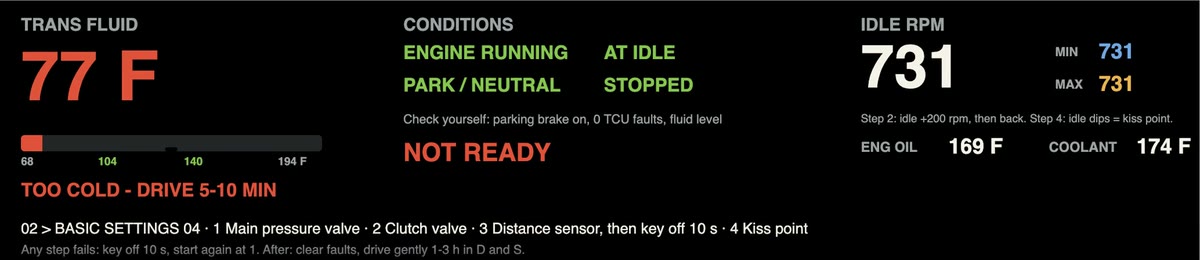
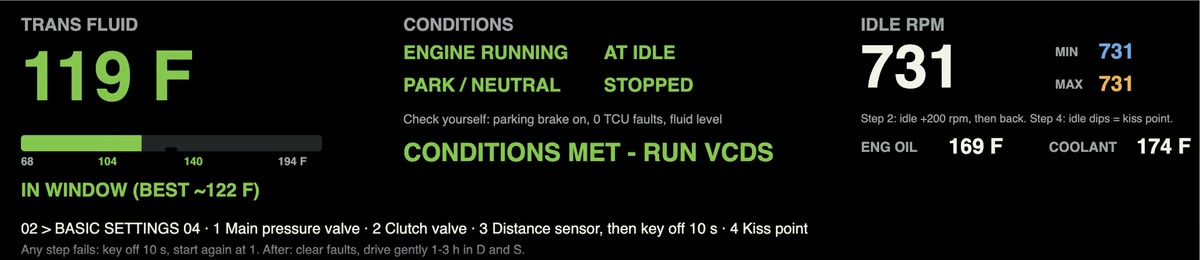
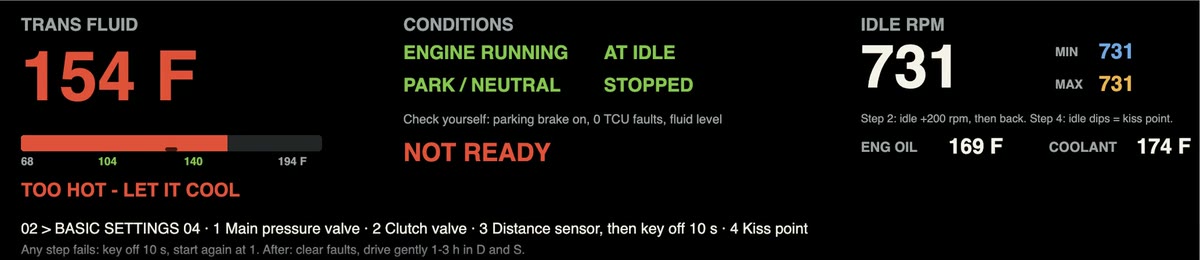
Celsius (the bTres set to °C)
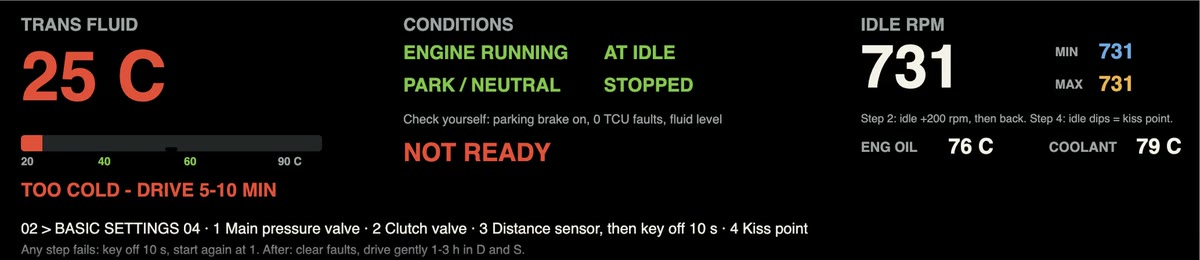
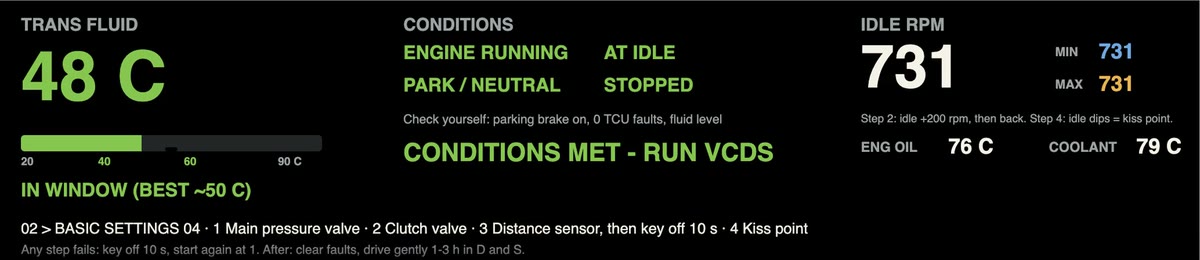
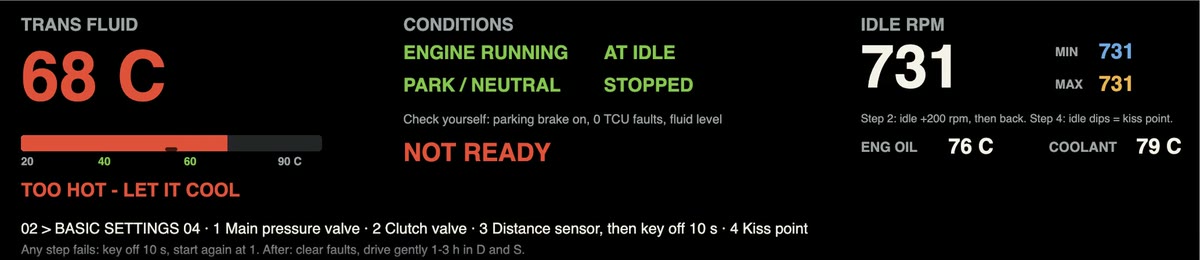
Idle RPM keeps a minimum and maximum, so you can see the idle rise in step 2 and the kiss-point dips in step 4.
Needs the DS1 plugged in. The screen stops updating when you unplug the DS1 to start VCDS. See the note above for how to use it.
Download the bTres screen (beta, .zip, 3 KB) How to add screens to the bTres S1/S2 Build your own bTres screen OK to Send It: a free main screen with boot animations
To install it, join the bTres Wi-Fi (password betterthan (the default; yours may differ)), open http://192.168.220.1, choose Custom Screens, upload the screen_adaptation_helper.json from the zip, then restart the bTres. Or import the zip in the bTres Screen Editor (Import/Export Screen → Import Screen ZIP).
The four adaptations, in this order. Start the engine and stay in P for all four.
Swipe sideways to see every step →
Note: Ross-Tech’s own list is shorter than the four steps below: it has no main pressure valve or kiss point step. The order here follows ECS Tuning and OBDeleven users.
Expect: idle rises on its own by about 200 rpm, then drops back. Clutch pressures climb toward roughly 20 bar if you watch them. Takes a minute or two.
Expect: clunks and clicks as it runs the shift forks through every gear, and a little shake in the car. That is normal. About a minute.
Expect: clutch 1 pressure creeps up until the idle dips, then falls off fast. That dip is the kiss point. Then clutch 2 does the same, near 2 bar. Seconds to a minute.
02 → Adv. Meas. Values, search “clutch”, add:
Done when both read completed or adapted. To speed it up, use manual mode and hold a steady 1,800–2,000 rpm in each gear for a while:
■ clutch 1 · odd gears ■ clutch 2 · even gears + R. A steady cruise in 4th, then 5th, covers both.